Predicting Indie Game Success: A Diverse Stacking Ensemble Approach for Consumer Demand Forecasting
DOI:
https://doi.org/10.67119/ngb9tq96Keywords:
Machine Learning, gaming industry, predictive analytics, player ownershipAbstract
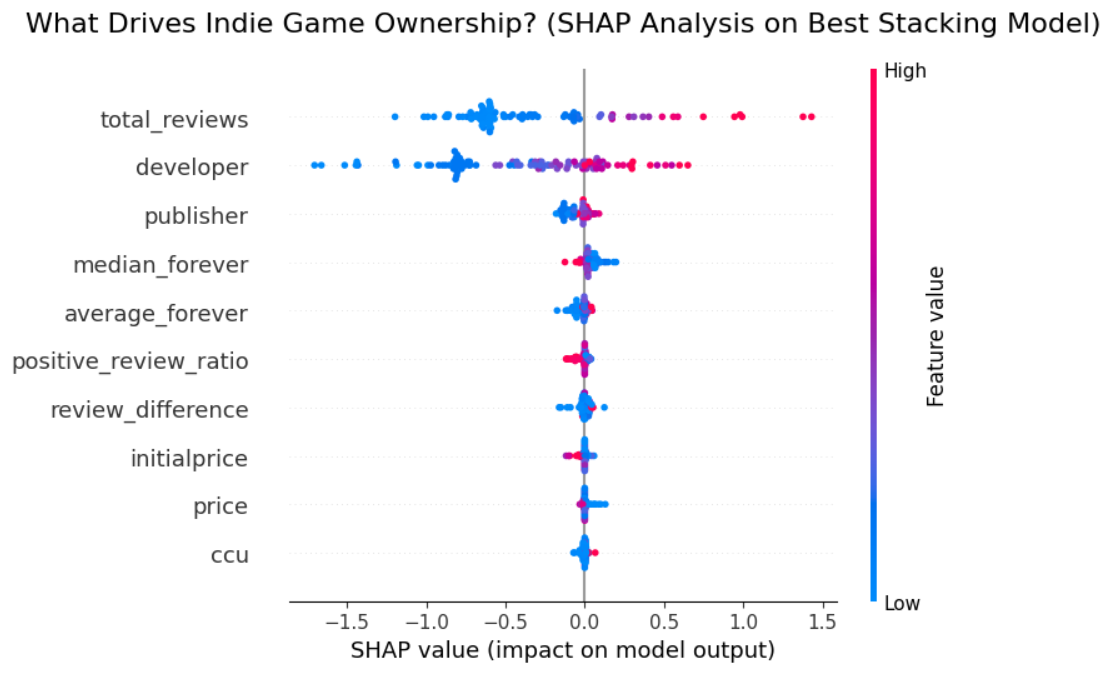
As consumer expectations escalate across the video game market, accurately understanding player preferences is crucial for maximizing profitability and long-term retention. This is particularly challenging for independent (indie) developers who lack the resources of AAA studios. However, forecasting game ownership using the vast, heavy-tailed data from digital distribution platforms remains a significant hurdle. To address this gap, we propose a specialized, robust machine learning framework exclusively tailored for the indie market segment. Our approach utilizes a Diverse Stacking Regressor ensemble—integrating Random Forest, XGBoost, LightGBM, and CatBoost algorithms alongside a Huber meta-learner—to predict game ownership based on comprehensive SteamSpy data. Compared to standalone baselines, such as a traditional Random Forest which achieved an $R^2$ score of 0.69 and a Median Absolute Error (MedAE) of nearly 100,000, our stacking approach demonstrates superior accuracy. It yields an $R^2$ score of 0.72, lowers the Mean Absolute Percentage Error (MAPE) to approximately 20\%, and reduces the MedAE from approximately 100,000 to under 5,500. Ultimately, this predictive framework empowers indie developers to systematically interpret large-scale consumer data, facilitating optimized resource allocation and data-driven game design.
Downloads
Downloads
Published
License
Copyright (c) 2026 All authors. All rights reserved.

This work is licensed under a Creative Commons Attribution 4.0 International License.