Optimizing Multi-Factory RemanufacturingScheduling Under Order Tardiness ConstraintsUsing Reinforcement Learning
DOI:
https://doi.org/10.67119/sqt1f218Keywords:
Production scheduling optimization, Multi-factory remanufacturing, Reinforcement learningAbstract
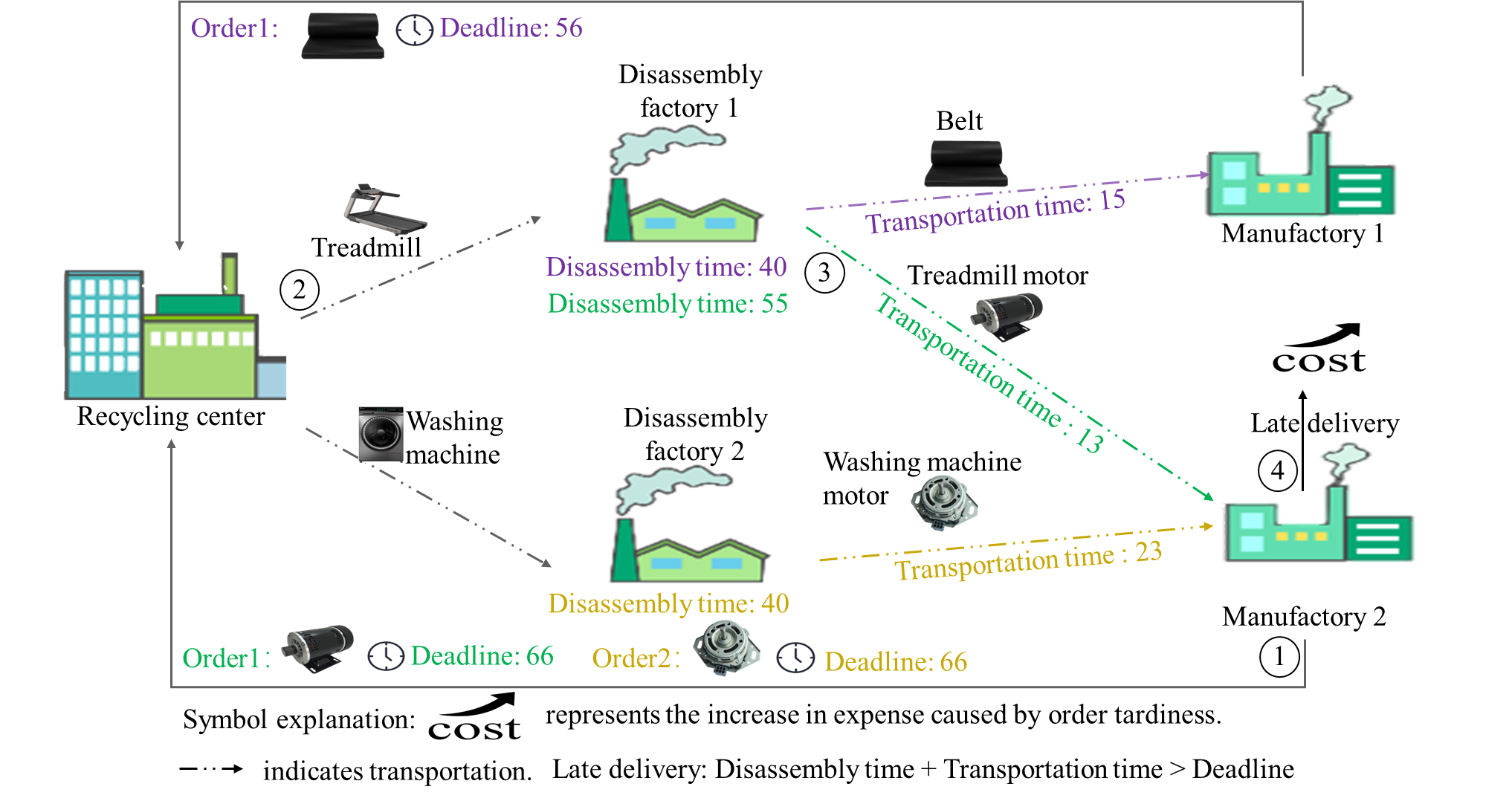
With the rapid development of manufacturing industries, particularly in remanufacturing, how to efficiently manage production scheduling across multiple factories has become an important research topic. The frequent occurrence of order tardiness, which refers to situations where orders are not completed within the required delivery time, poses a significant challenge, negatively impacting production efficiency and customer satisfaction. Therefore, optimizing multi-factory remanufacturing systems under order tardiness constraints has become a critical issue in both theory and practice. To address this problem, this study develops a mathematical model with the objective of minimizing total costs. By optimizing production scheduling through this model, the losses caused by order timeouts in disassembly operations can be effectively reduced. The model is first validated using the CPLEX optimization solver to ensure its feasibility and accuracy. Subsequently, the Deep Double Q-Network (DDQN) algorithm is applied to solve the problem, as it is well-suited for complex decision-making under dynamic conditions. The performance of DDQN is further compared with two widely used reinforcement learning approaches: Advantage Actor-Critic (A2C) and Proximal Policy Optimization (PPO). A simulation environment is constructed to align with the characteristics of the multi-factory remanufacturing system. The results demonstrate that the DDQN algorithm significantly outperforms A2C and PPO, achieving higher system efficiency and better stability, particularly in managing order timeout constraints. This research offers a novel approach to the optimization of multi-factory remanufacturing systems and provides valuable insights for industrial applications and future studies.
Downloads
Downloads
Published
License
Copyright (c) 2026 All authors. All rights reserved.

This work is licensed under a Creative Commons Attribution 4.0 International License.