Energy-Efficient Task Allocation for Smart Traffic Signal Control in Edge-Cloud Hierarchies
DOI:
https://doi.org/10.67119/5150ep54Keywords:
Cloud–edge–device collaboration, dual-mode offloading, energy optimizationAbstract
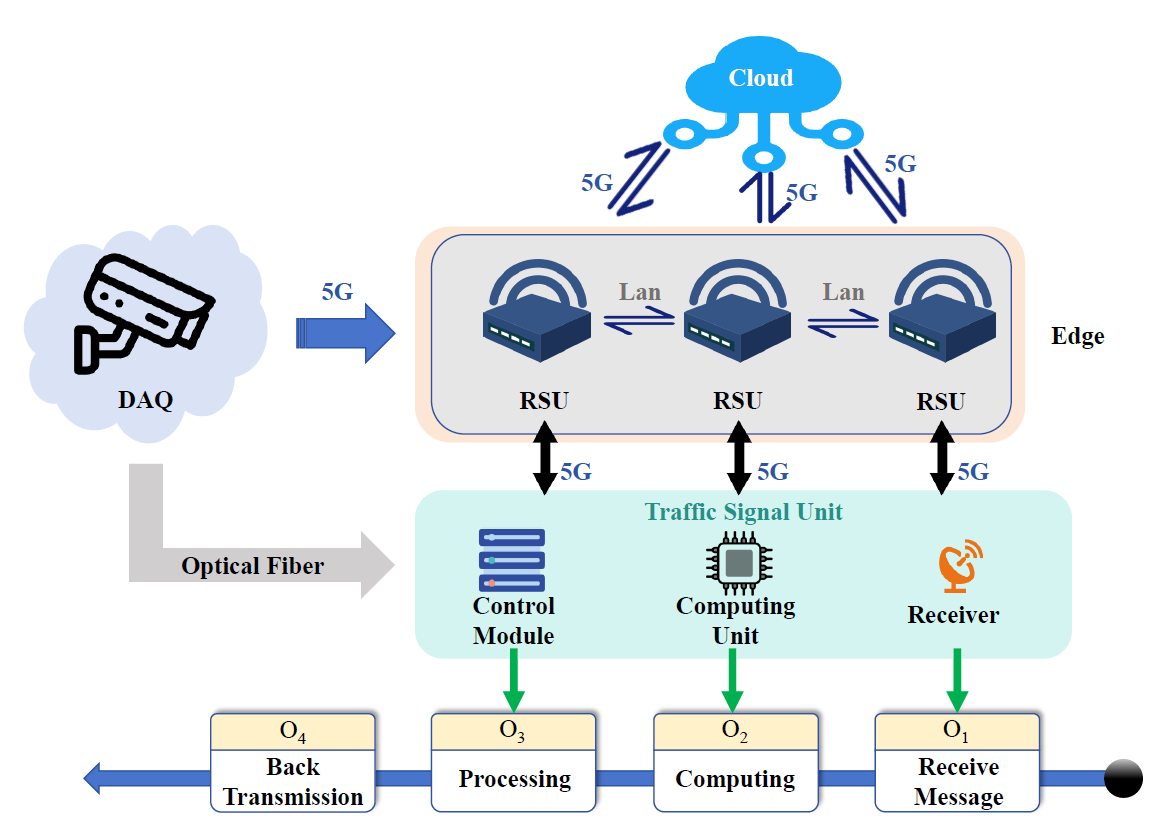
In smart traffic signal control, large-scale urban road networks increasingly rely on distributed sensing, communication, and computation resources deployed at intersections, roadside facilities, and remote cloud platforms. These heterogeneous resources must collaboratively process massive numbers of delay-sensitive and computation-intensive tasks under stringent energy and security requirements. This work investigates energy-minimized task allocation in a three-layer architecture that includes field traffic signal controllers, roadside computing units, and a centralized cloud data center. A dual-mode optimization model is formulated that integrates a general unconstrained offloading mode with a security-aware offloading mode, where highly sensitive tasks are forced to remain local. The objective is to minimize total energy consumption by jointly modeling computation latency, communication latency, dynamic processing energy, and transmission energy, while respecting resource capacity and delay bounds. To efficiently search this non-convex, constrained solution space, an adaptive constraint-enhanced metaheuristic algorithm is developed, incorporating dynamic penalty adjustment, hybrid early termination, adaptive population regulation, and pruning strategies for infeasible solutions. Experimental results on large-scale synthetic traffic workloads demonstrate that the proposed algorithm achieves lower energy consumption and faster convergence than several representative metaheuristic baselines, and can be effectively applied to resource scheduling in smart traffic control systems.
Downloads
Downloads
Published
License
Copyright (c) 2026 International Journal of Artificial Intelligence and Green Manufacturing

This work is licensed under a Creative Commons Attribution 4.0 International License.