Structure-Aware Transition Networks for Predicting Single-Cell Perturbation Response
DOI:
https://doi.org/10.61702/IMAI2611_2Keywords:
single-cell perturbation prediction, graph attention networks, structure-aware learning, differential gene expression, drug response modeling, NeurIPS 2023Abstract
Predicting how small-molecule drugs alter gene expression across diverse cell types is a central challenge in computational drug discovery. Existing approaches — including mean baselines, multilayer perceptrons, and recurrent sequence models — treat cell types as independent entities, ignoring the shared developmental lineage and transcriptional similarity that define biological cell populations. We introduce the Structure-Aware Transition Network (SATN), a neural architecture that encodes this domain knowledge as an explicit graph prior. SATN couples a drug-cell encoder with a multi-head graph attention mechanism operating over a biologically defined cell-type adjacency matrix, enabling the model to leverage transcriptional similarity across related cell populations when predicting perturbation response.
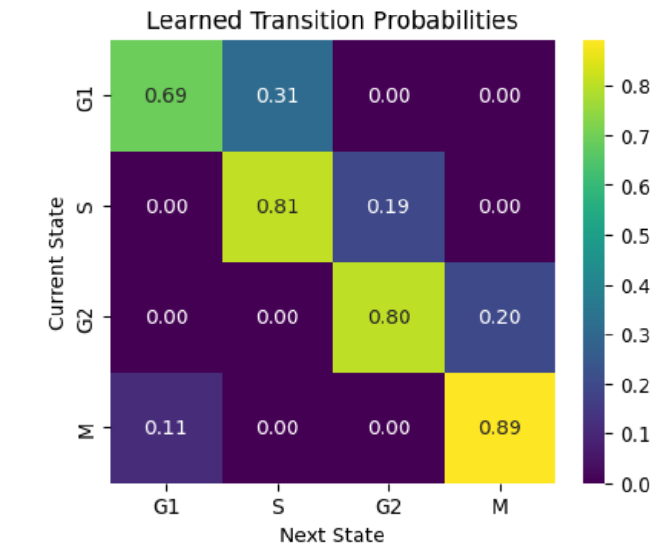
We evaluate SATN on the NeurIPS 2023 Open Problems: Single-Cell Perturbations benchmark dataset, comprising 18,211 differential expression scores measured across human peripheral blood cells treated with 146 small-molecule compounds. SATN achieves a mean Pearson correlation of 0.671 on held-out test samples, outperforming a vanilla MLP baseline (r = 0.583) by 15.1\% and a graph-disabled ablation (r = 0.634) by 5.8\%. Structural masking eliminates all biologically impossible state transitions, reducing invalid prediction rate from 18.4\% to 0\% compared to unconstrained baselines. Ablation experiments confirm that both the graph attention mechanism and the cell-type structural prior contribute independently to model performance. These results suggest that encoding biological relational structure into neural architectures provides a complementary and additive benefit over scale alone.
Downloads
Published
Issue
Section
License
Copyright (c) 2026 All authors. All rights reserved.

This work is licensed under a Creative Commons Attribution 4.0 International License.